Data description/Result options

Contents
Iteration monitor list for pipeline analysis with non-linear soil and geometrically non-linear pipe behaviour (Output Table)
Data description/Result options:
ITER:
Iteration sequence number (n)
REMARK:
Type of iteration in case of non-linear calculations
Infinite Bend Angle |
No effect of joining straight pipe on bend stiffness taken into account |
Limited Bend Angle |
Effect of joining straight pipe on bend stiffness taken into account |
Non-ovalising |
No effect of ovalisation on stiffness taken into account |
Ovalising |
Effect of ovalisation on axial stiffness taken into account |
Material Nonlinear |
Material non-linearity taken into account |
Non-oval./Oval. |
|
Oval./Mat. Nonlin. |
|
Non-oval./Mat. Nonlin. |
NLERFLDS:
Number of soil lateral reaction error fields after soil iter (n) (1)
NFERFLDS:
Number of soil axial friction error fields after soil iteration(n) (1)
NTERFLDS:
Number of soil torsional friction error fields after soil iter (n) (1)
NERFLDS:
Summated number of soil iteration error fields (1)
(NERFLDS = NLERFLDS + NFERFLDS + NTERFLDS)
MFERPTS:
Max. no. of soil iteration error points occurring in 1 error field (1) (2)
NERPTS:
Total number of soil iteration error points contained in NERFLDS including error points at boundary nodes (1) (3)
DISEQ:
Disequilibrium indicator
(The disequilibrium indicator is the lower (truncated) integer ratio of:
The norm of the disequilibrium force vector divided by the norm of the total external+internal force vector and the specified RELDISEQ or ABSDISEQ value.
DISEQ = 9999 for all values ≥ 9999
DISEQ = 0 means 'NEAR STABILITY'
DISEQ = 'blank' means 'STABILITY' (see also the table description))
DISPMAX:
Calculated overall maximum translation
DISPADD:
Calculated maximum additional translation
(The DISPADD value is the maximum translation displacement found in this iteration due to 100% of the disequilibrium load. The additional translation does not necessarily add to DISPMAX.)
IT.FACTOR:
Multiplication factor on the disequilibrium load used in this iteration. Effective addition to displacements is DISPADD*IT.FACTOR
 The number of rows is the number of iterations required to meet SOILCTL and GEOMCTL criteria.
Note 1: (these numbers are generated only during soil iterations)
•An 'error point' is a node where a deviation occurs
•An 'error field' is a series of consecutive nodes where a deviation occurs; a chain of 'error points'. One or more error-free nodes end a field, and the next field begins with the first subsequent node that has an error
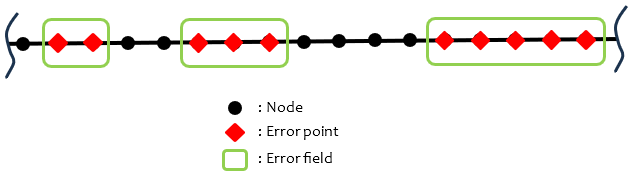
A deviation or error occurs when, after the iteration, the calculated ground reaction falls outside the range defined by the soil curve plus or minus the VARAR percentage value. The value of VARAR can be specified in the Soil Data (Design Function 3.2).
MFERPTS is the number of nodes in the longest 'error field'.
NERPTS is the total number of nodes across all 'error fields' combined.
H500511 (last modified: Aug 26, 2025)
See also: